"Let us be the first; something must be done by someone first."
The EmigrantsThe expression “Let us be the first; someone must be first, in everything” condenses Karl Oskar’s answer to the uncertainty surrounding emigration from Sweden. Spoken during his repeated discussions with Kristina, it makes pioneering not proof that the journey is safe but a reason to accept responsibility for taking it. The resolve becomes practical: he arranges passage on the Charlotta, sells Korpamoen, and leads his household toward Karlshamn and the Atlantic crossing.
The argument in Korpamoen
For four years, Karl Oskar and Kristina had struggled at Korpamoen, ending up several hundred riksdaler poorer than when they began. Remaining promised further exhausting labor and, in old age, little more than the reserved room and meager bread. Emigration offered the possibility of better prospects, but the prospect was not a guarantee: the land across the ocean was still unseen by anyone they knew, and rumors and printed accounts could not provide Kristina with a deed, an agreement, or trustworthy firsthand testimony.
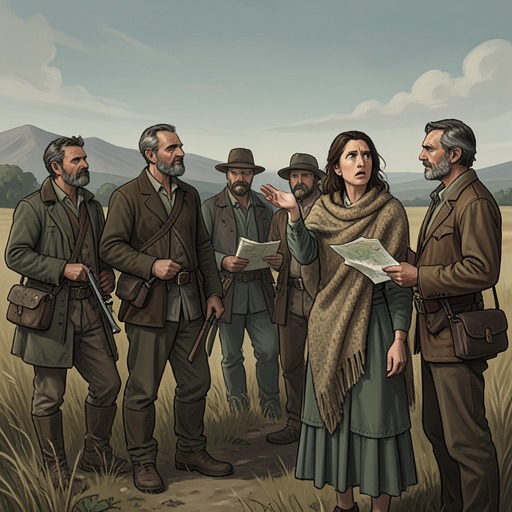
Their disagreement played out over many autumn evenings as they worked by the fire. Kristina’s objection returned to the absence of precedent: no one in their district had gone before them. Karl Oskar’s answer was always that someone had to be first. When she asked whether he would shoulder the responsibility, he answered that someone had to accept responsibility in any undertaking. The exchange gives the expression its force: it does not resolve Kristina’s doubts or supply the missing evidence; it names the burden Karl Oskar is willing to carry despite them.
From resolve to departure
The decision required more than conviction. Karl Oskar and Robert had written to a firm in Karlshamn and secured a promise of passage on the merchant vessel Charlotta, with a 100-daler down payment for six people. They planned to embark in the second week of April and sail directly to New York. Karl Oskar also told Danjel that Robert would seek a passage contract for Danjel’s household if the ship had room, extending the journey beyond the original family plan.
The costs made the uncertainty tangible. After selling Korpamoen and auctioning its belongings and livestock, Karl Oskar had 1,200 daler left after debts. Passage for three adults and three children cost 675 daler; after paying it, he expected to reach America with about 500 daler, before entrance fees and onward travel. He hoped to obtain land almost free, but recognized that little money would remain for farm tools and cattle. He had Kristina sew the remaining money into a sheepskin bag he could wear against his body. The promise of being first thus led not to a leap without preparation but to a sequence of costly, practical commitments.
A first journey becomes a group undertaking
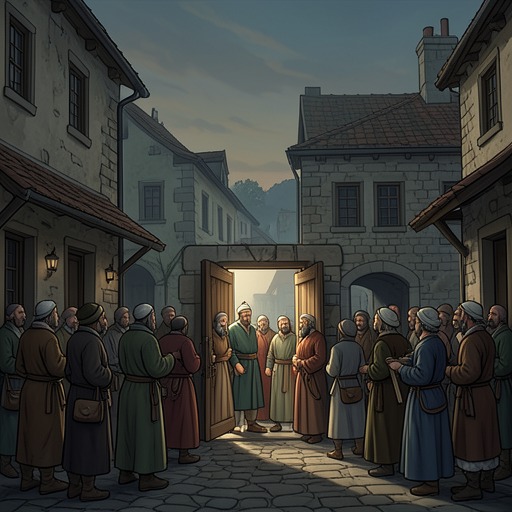
At Åkerby Junction, the emigrants’ separate household decisions came together. Danjel traveled with his wife, four children, and Ulrika of Västergöhl; Jonas Petter drove his own wagon, carrying his hired man, Arvid, and Elin among his passengers. Robert joined them there, reuniting with Arvid as the two former farmhands from Nybacken continued toward the New World together. The group numbered sixteen emigrants—nine adults and seven children—while three drivers were to return from Karlshamn.
The gathering altered the meaning of Karl Oskar’s resolve. He had spoken of going first from a district where no one they knew had emigrated, but the departure was no longer a solitary family venture: distinct pressures and plans had converged into a collective movement. Jonas Petter called them a large family and raised the question of who would lead it. The others looked to Karl Oskar, though he pointed out that he was the youngest of the three farmers and named Jonas Petter as the oldest. The journey depended on shared arrangements and relationships as well as on the individual willingness to begin.
The cost and consequence of beginning
The novel places this private exchange within a wider stir in rural communities. News of fertile American land traveled through neighboring farms and parishes, while uncertainty divided those willing to risk the ocean from those who trusted the familiar home. The Ljuder emigrants did not share one motive: crop failure, religious persecution, dissent, personal difficulties, social exclusion, and unfair employment practices each helped drive someone from Sweden. Karl Oskar’s words are therefore a personal answer to a broader movement, not a single explanation for it.
The journey also exposes the distance between imagined promise and lived hardship. After storms, illness, and confinement at sea, the passengers sighted the green earth near New York. The vision revived the exhausted emigrants, whose strength and ambition returned as they recognized that the crossing was over. That arrival confirms the physical completion of the undertaking, not every expectation about life in America. The expression’s lasting significance lies in the choice it records: when no trusted precedent could make the unknown certain, Karl Oskar accepted responsibility for beginning—and his first step became part of a group’s passage into a new land.